
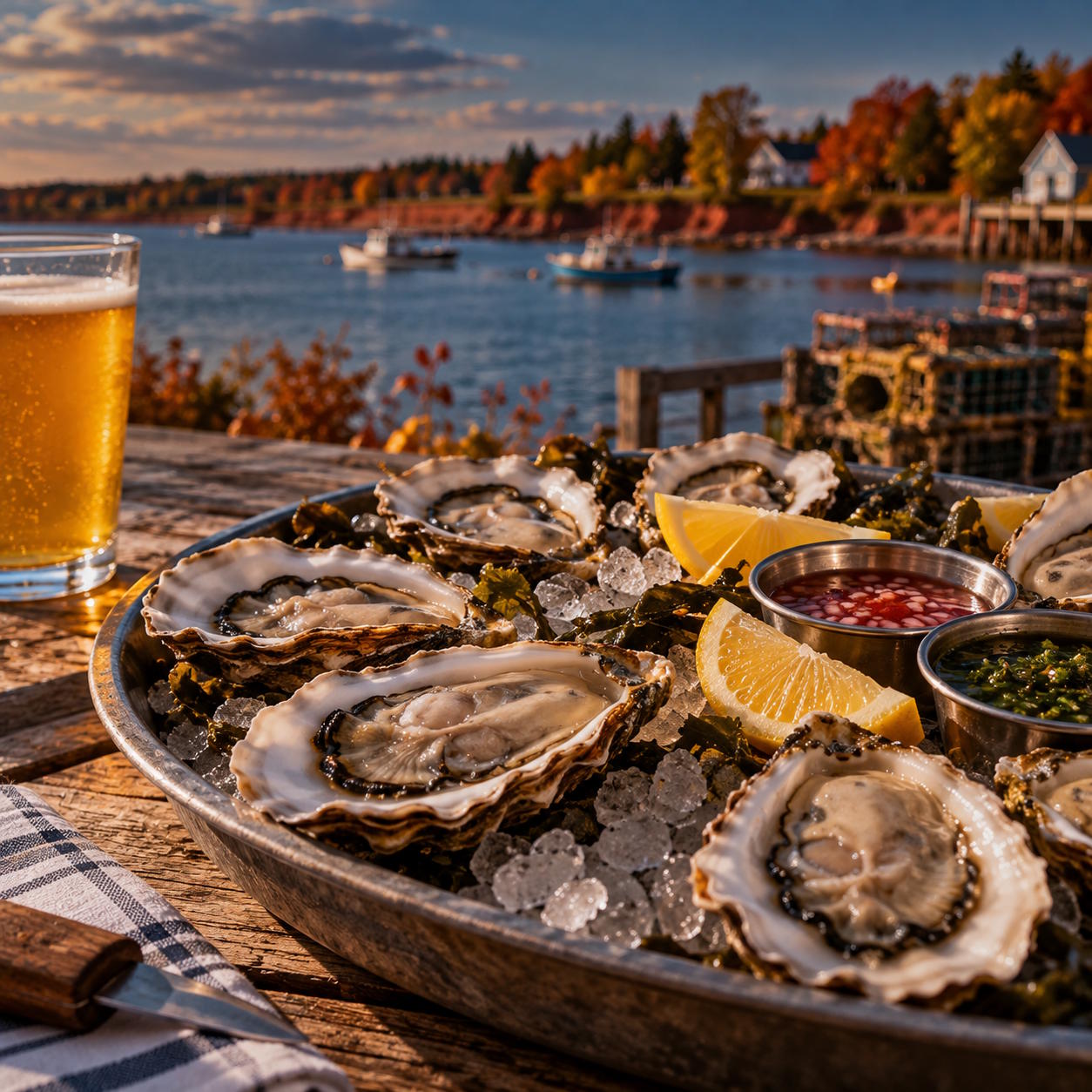

Prince Edward Island is famous for potatoes, lobster and mussels, but ask someone who really loves seafood what you shouldn’t leave the Island without trying and there’s a good chance they’ll give you a different answer.
Oysters.
PEI oysters are served around the world, but eating them here is different. You can try oysters grown in different bays around the Island, compare how their flavours change depending on where they’re raised, order them freshly shucked at a Charlottetown oyster bar or seek them out closer to where they’re grown.
And fall is a particularly good time to start exploring.
PEI oysters are harvested and available throughout the year, so there isn’t a short “oyster season” in the way visitors sometimes imagine. But as the water gets colder, oysters are no longer putting energy into spawning. The result can be plumper meat and fuller flavour, which is why many oyster lovers particularly enjoy them through the colder months.
If you’re visiting PEI this fall, here’s what to know, what to try and where to start.
Are oysters in season in PEI in the fall?
Quick Answer: Yes. PEI oysters are available fresh year-round, including throughout the fall. As Island waters cool, oysters are no longer spawning, and many oyster lovers consider the cooler fall and winter months an especially good time to eat them because the meat can be plumper and more flavourful.
You’ve probably heard the old advice about eating oysters only during months containing the letter “R.”
That means September through April.
Modern aquaculture, refrigeration and food-safety practices mean you don’t need to follow that rule to enjoy PEI oysters. Island producers harvest and sell oysters throughout the year.
But there is some logic behind the traditional preference for cooler months.
Oysters reproduce when the water warms. During that process, their texture and appearance can change because they’re putting energy into spawning.
By fall, PEI’s waters are cooling again.
That’s why October isn’t simply a convenient month to write about oysters. It’s genuinely a good time to eat them.
Why is PEI famous for oysters?
Quick Answer: PEI’s cold, clean coastal waters and numerous bays and estuaries create excellent conditions for growing oysters. The Island produces many named varieties, and differences in water, salinity, tides and growing location can give oysters from different parts of PEI noticeably different flavours and textures.
Here’s the first thing to understand about PEI oysters:
They’re not all the same.
The oysters grown around Prince Edward Island are influenced by the particular body of water where they’re raised. Salinity, tides, currents, food sources and growing methods can all affect the finished oyster.
It’s similar to the idea of terroir in wine.
With oysters, you’ll sometimes hear the term merroir instead.
That’s why an oyster menu in PEI may list several Island names rather than simply saying “PEI oysters.”
Raspberry Point. Lucky Lime. Irish Point. Pickle Point. Colville Bay.
Those names actually tell you something.
What PEI oysters should you try?
Quick Answer: Some of PEI’s best-known oysters include Raspberry Point, Lucky Lime, Pickle Point, Irish Point and Colville Bay. There isn’t one universally “best” PEI oyster. Each growing area produces a different balance of brine, sweetness, minerality, texture and finish, so trying several side by side is part of the experience.
If you’re new to oysters, don’t worry about finding the definitive best one.
Order a few different varieties.
That’s much more interesting.
Raspberry Point
Raspberry Point oysters are grown in the cool waters of New London Bay on PEI’s North Shore.
They’re one of the Island’s best-known names and a very approachable place to start. Raspberry Point describes its namesake oyster as salty and clean with a sweet finish.
The producer’s northern growing waters also mean these oysters develop slowly. Raspberry Point says its oysters can take roughly four to six years to reach market size.
Lucky Lime
Lucky Limes also come from the New London Bay area, near the PEI National Park dunes.
They’re recognizable for their bright green shells and are produced in relatively limited quantities.
If you’re ordering a mixed plate and see Lucky Limes on the list, add a couple.
Pickle Point
Pickle Points are grown in Hope River and New London Bay.
They’re known for thick shells, firm meat and a pronounced salty character.
If you’re trying several oysters together, this is exactly the kind of variation worth looking for. Don’t immediately cover everything with hot sauce or mignonette. Try the first one on its own.
Irish Point
Irish Points are smaller cocktail oysters grown in the cold waters around Hope River.
They tend toward a salty profile with an earthy, citrus-like finish.
Again, the point isn’t memorizing tasting notes.
It’s discovering that two oysters grown on the same Island can taste noticeably different.
Colville Bay
Head east to the Souris area and you’ll encounter another famous PEI name.
Colville Bay oysters are grown near the mouth of the Souris River and are recognizable by their aqua-green shells. Tourism PEI describes their flavour as distinctly salty-sweet.
They’re also a favourite in Tourism PEI’s own local recommendations.
If you see them on a menu beside oysters from central or western PEI, you’ve got the makings of a pretty good Island tasting flight.
Where are the best places to eat oysters in Charlottetown?
Quick Answer: Charlottetown has several excellent options for PEI oysters, including Claddagh Oyster House, Sea Rocket Oyster House, Sims Corner Steakhouse & Oyster Bar and Merchantman Fresh Seafood & Oyster Bar. The best choice depends on whether you want a dedicated oyster experience, casual seafood or a more upscale night out.
You do not have to travel to an oyster farm to eat excellent oysters on PEI.
Charlottetown is one of the easiest places to try several varieties.
Claddagh Oyster House
If the word “oyster” is in the name, expectations are fairly high.
Claddagh earns its place on the list by making Island oysters a central part of the restaurant rather than an afterthought.
The restaurant’s oyster selection changes with season and availability, which is exactly what you’d want from a place specializing in local shellfish. It also serves cooked preparations, including Oysters Rockefeller.
For someone visiting Charlottetown specifically looking for an oyster dinner, this is one of the obvious places to start.
Sea Rocket Oyster House
Sea Rocket puts seafood and shellfish at the centre of the experience.
Tourism PEI specifically recommends it for oysters, including both fresh and baked preparations.
If you’re not sure you’re ready to eat half a dozen completely raw oysters, baked oysters can also be a good introduction.
Or order both.
Sims Corner Steakhouse & Oyster Bar
Sims is a good choice when one person at the table is oyster-obsessed and someone else would rather order PEI beef.
Tourism PEI highlights its rotating selection of Island oysters, making it another good option for comparing different growing areas without leaving downtown Charlottetown.
Merchantman Fresh Seafood & Oyster Bar
Merchantman is another downtown option, located near the Charlottetown waterfront.
It’s open year-round, which becomes particularly important as you move deeper into fall and some of PEI’s more seasonal seafood destinations close for the year.
That’s worth remembering if you’re visiting in October.
Always check current menus and hours before heading out specifically for oysters. Varieties change with availability, and seasonal PEI businesses can change their hours quickly once summer ends.
Where can you try PEI oysters outside Charlottetown?
Quick Answer: Great oyster experiences aren’t limited to Charlottetown. Depending on the season, you can find oysters around PEI at places such as Carr’s Oyster Bar in Stanley Bridge, Brackley Bay Oyster Co., and seafood restaurants in eastern and western PEI. Some producers also offer oyster harvesting and shucking experiences.
This is where oysters can become more than dinner.
PEI’s oyster industry stretches around the Island, so where you eat them can be part of the experience.
Tourism PEI recommends Carr’s Oyster Bar in Stanley Bridge for its waterfront setting and local oysters. It also highlights Brackley Bay Oyster Co., where visitors can eat oysters from the same operation that grows them.
In eastern PEI, oyster experiences and producers around places such as Cardigan and Souris offer another perspective entirely.
There are even experiences where you can learn how oysters are harvested and shucked.
If you’re travelling outside Charlottetown, check operating dates carefully. Many tourism-oriented restaurants and oyster experiences are seasonal, and some finish their year before October.
The oysters don’t disappear when summer ends.
Some of the places serving them do.
What’s the best way to eat a PEI oyster for the first time?
Quick Answer: Start with a freshly shucked raw oyster and taste it before adding anything. Loosen the oyster from its shell, tip it into your mouth and chew it a few times. Then try another with lemon, mignonette or hot sauce to see which preparation you prefer.
You don’t need to pretend to know what you’re doing.
Nobody is grading you.
If you’re served several varieties, ask which is which and start with the milder oyster before moving toward stronger, saltier varieties.
Then:
- Make sure the oyster has been loosened from the shell.
- Try your first one without toppings.
- Chew it rather than swallowing it immediately.
- Pay attention to the saltiness, sweetness, texture and finish.
- Try the next one with lemon or mignonette if you’d like.
Once you start comparing them, oysters get considerably more interesting.
One might be intensely briny. Another can seem sweeter. Another might finish with a mineral or almost cucumber-like character.
You don’t need sophisticated tasting vocabulary.
You just need a second oyster.
What beer pairs best with PEI oysters?
Quick Answer: Crisp, highly carbonated beers such as pilsners are particularly easy matches for fresh oysters because they refresh the palate without overwhelming the oyster’s delicate briny flavour. Lone Oak’s Fixed Link Maritime Pilsner is a natural PEI pairing, with a clean, bright profile and snappy bitterness.
Wine gets most of the attention with oysters.
Beer deserves a seat at the table.
For raw oysters, we’d generally avoid starting with the biggest, strongest beer available. The oyster itself is delicate, so you want something refreshing enough to clear the palate without burying its flavour.
That’s where pilsner works particularly well.
Fixed Link, our Maritime Pilsner, is made with PEI malt and Maritime-grown hops. It’s light-bodied, bright and highly drinkable, with enough bitterness to reset your palate between oysters.
And there’s something appropriate about pairing a PEI-grown oyster with a beer named after the bridge connecting PEI to the mainland.
If you’re experimenting with baked oysters or richer toppings, you can move toward beers with more hop character or malt depth.
But for a freshly shucked oyster?
Keep it crisp.
Can you buy PEI oysters to take home?
Quick Answer: Yes. Fresh PEI oysters are available from producers, seafood markets and some retailers across the Island. Raspberry Point, for example, harvests and sells oysters year-round. If you’re travelling with oysters, ask the seller about proper storage and transport so they remain safely chilled.
You don’t necessarily have to eat your oysters at a restaurant.
Several Island producers and seafood retailers sell oysters directly.
Raspberry Point harvests year-round, while Tourism PEI also points visitors toward local producers and oyster outlets around the Island.
If you’re staying somewhere with a kitchen, buying a couple dozen oysters and learning to shuck them can be one of the better PEI food experiences you can create yourself.
Just make sure you know how to handle them safely.
Oysters need to remain properly refrigerated, and transporting live shellfish requires more care than tossing a souvenir into the trunk.
Ask whoever sells them to you for storage instructions.
And if you’ve never shucked before, use a proper oyster knife and learn the technique before improvising with whatever knife happens to be in the rental cottage.
Your hands will thank you.
Are PEI oysters only a summer experience?
Quick Answer: No. PEI oysters are harvested and sold throughout the year, and cooler months can actually be an excellent time to eat them. While some seasonal oyster restaurants and tourism experiences close after summer, year-round restaurants and producers make PEI oysters a fall and winter food as well.
This might be the biggest misconception.
Oysters look like summer food.
A waterfront patio, crushed ice, lemon wedges and a cold drink make a pretty convincing argument.
But the oyster itself doesn’t care that patio season ended.
In fact, Tourism PEI notes that oysters can be particularly good during the colder months because they’re no longer spawning and may be plumper and more flavourful.
So if you’re visiting PEI in October and assuming you’ve missed oyster season, you haven’t.
You may have missed a few seasonal restaurants.
That’s different.
What else should you eat on an oyster trip around PEI?
Quick Answer: Build a PEI food day around more than oysters. Mussels, lobster, fish and chips, Island beef and PEI potatoes are all natural additions, while local breweries give you a chance to pair Island food with beer made here as well.
Nobody needs to eat oysters for breakfast, lunch and dinner.
Probably.
If you’re travelling around PEI in search of seafood, use oysters as the beginning rather than the entire itinerary.
Try mussels.
Get fish and chips.
Stop somewhere serving local beef.
Find a brewery and see what they’re pouring.
One of the advantages of exploring PEI through food is that you don’t have to manufacture an itinerary. The Island’s communities, farms, harbours, restaurants and breweries give you one naturally.
And in fall, you get another bonus.
The drive between them is half the experience.
So, where are the best oysters in PEI?
Quick Answer: There isn’t a single best PEI oyster or one best place to eat them. Start with several Island-grown varieties, compare oysters from different bays and choose restaurants that take their oyster program seriously. Charlottetown offers the easiest concentration of options, while travelling around PEI gets you closer to the places they’re grown.
The best oyster in PEI might be Raspberry Point.
Or Colville Bay.
Or Lucky Lime.
Or something on tonight’s menu whose name you’ve never heard before.
That’s the fun of asking.
PEI isn’t known for one oyster. It’s known for producing oysters in bays and estuaries around the Island, each influenced by the water and environment where it grew.
So don’t come looking for one winner.
Order three varieties.
Try the first without anything on it.
Ask where it came from.
Have another.
And if there’s a cold PEI beer sitting beside the plate, even better.
Fall on Prince Edward Island gets a lot of attention for changing leaves and quieter roads.
It should get a little more attention for oysters, too.
Frequently Asked Questions About PEI Oysters
1. When is the best time to eat oysters in PEI?
PEI oysters are available year-round, but fall and the colder months are an excellent time to enjoy them. As water temperatures cool and oysters move beyond their spawning period, they can become plumper and more flavourful.
2. What makes PEI oysters special?
PEI’s cold, clean coastal waters and numerous bays and estuaries provide excellent oyster-growing conditions. Different growing areas also produce variations in brininess, sweetness, texture and mineral flavour.
3. What are some popular PEI oyster varieties?
Well-known PEI oysters include Raspberry Point, Lucky Lime, Pickle Point, Irish Point and Colville Bay. Restaurants and oyster bars may carry different varieties depending on season and availability.
4. Where can you eat oysters in Charlottetown?
Charlottetown has several restaurants and oyster bars specializing in PEI seafood, including Claddagh Oyster House, Sea Rocket Oyster House, Sims Corner Steakhouse & Oyster Bar and Merchantman Fresh Seafood & Oyster Bar.
5. Can you visit an oyster farm in PEI?
Yes. PEI has oyster producers and experiences where visitors can learn more about how oysters are grown, harvested and shucked. Availability can be seasonal, so check directly with operators before visiting.
6. Are PEI oysters available in the fall?
Yes. PEI oysters aren’t limited to summer. Fall can actually be an excellent time to eat them, and oysters continue to be available during the colder months.
7. How should you eat a PEI oyster for the first time?
Try the oyster on its own first so you can taste its natural brininess, sweetness and mineral character. After that, add lemon, mignonette, hot sauce or another accompaniment if you prefer.
8. Do oysters from different parts of PEI taste different?
Yes. Water conditions, salinity, food sources and growing methods can influence an oyster’s flavour and texture. Comparing oysters from different PEI bays is one of the best ways to experience those differences.
9. What beer pairs well with PEI oysters?
Crisp, lighter beers such as pilsners are excellent with raw oysters because they refresh the palate without overpowering their delicate flavour. Lone Oak’s Fixed Link Maritime Pilsner is one local pairing option.
10. What other PEI seafood should you try in the fall?
PEI mussels are another Island staple worth trying, along with whatever locally sourced seafood is available on current restaurant menus. Fall is a great time to build a meal around several PEI-grown or harvested ingredients.